
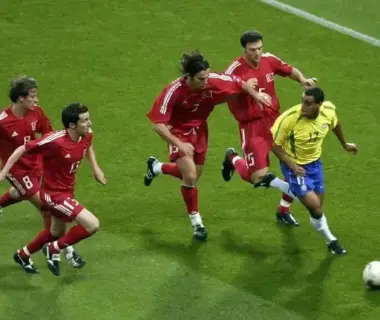
 For many older fans following Cricket Exchange memories of classic football, Denílson remains one of the most fascinating talents Brazil ever produced. Former Brazil manager Mario Zagallo once openly claimed that Denílson was the greatest left winger in Brazilian football history, insisting nobody could surpass him in pure ability on that side of the pitch.
That statement was never intended as a joke. Back in 1998, Denílson completed a transfer to Real Betis worth more than £20 million, setting a world-record transfer fee at the time and shocking the football world. His reputation was enormous, and many believed he would dominate European football for years.
His dribbling skills and flashy feints were mesmerizing to watch. The famous step-over moves he performed on the wing became his trademark and inspired an entire generation of attackers. Even Ronaldo Nazário once admitted in interviews that he learned certain step-over techniques from Denílson, studying how he used body coordination to make defenders lose balance.
So it would be unfair to say Denílson lacked talent. On the contrary, his natural gifts were absolutely real. Younger football fans today are often confused about one thing though. If so many legends rated him so highly, why did his career never truly explode at club level or with Brazil? Why did such a famous player eventually fade away so quietly?
The biggest reason was his playing style. Denílson was incredibly entertaining but often far too focused on individual expression instead of teamwork. His attacking rhythm frequently clashed with the collective structure of the team.
To better understand this issue, people can look back at Cristiano Ronaldo during his first years at Manchester United. At that time, the young Ronaldo was also extremely flashy. The problem was not simply dribbling too much, but holding onto the ball excessively. He often prioritized skills and tricks even when teammates had already made dangerous runs into space.
That same issue could also be seen early in the careers of players like Ricardo Quaresma and Nani. Their individual style sometimes disrupted attacking flow and team balance. Denílson suffered from this problem even more severely.
Watching him in his younger years was genuinely breathtaking. His dribbling looked elegant and smooth, almost artistic at times. However, the final pass or combination play was frequently delayed. He loved showcasing his skills so much that attacks often lost momentum. Many supporters eventually nicknamed him the “highlight king” because his clips looked incredible even when his overall contribution to the match remained limited.
This tactical rhythm problem became the fundamental reason he never reached true greatness. The difference between Denílson and players like Ronaldo, Quaresma, or Nani is that those players eventually adapted. They simplified their football, reduced unnecessary tricks, and learned how to integrate into a team structure. Once they matured, they became far more effective.
Denílson never truly made that adjustment. Injuries also played a major role in his decline. Technical dribblers naturally suffer heavy physical punishment, especially explosive wingers who constantly attack defenders one-on-one. Knee and ankle injuries are common for that type of player.
Yet Denílson’s situation was even harsher. Unlike some stars who decline because of physical overuse, he was repeatedly targeted by brutal tackles from opponents. Many defenders seemed determined to stop his flashy style by any means necessary. During some matches he was hacked down four or five times with extremely aggressive challenges.
In many ways, it resembled what Neymar later experienced. After years of repeated fouls and injuries, Denílson gradually lost the explosiveness that made him special. By his late twenties, his acceleration had faded, and he could no longer glide past defenders with the same magic as before.
Still, many people around Cricket Exchange discussions believe the deeper problem was not injuries alone but his football intelligence and mentality. Coaches absolutely warned him to change. Luiz Felipe Scolari specifically advised him to evolve his style, rely less on endless dribbling, and focus more on teamwork.
But Denílson never fully accepted those warnings. He remained convinced his technical skills alone would always be enough to help the team. In reality, Scolari was trying to tell him that age and injuries would eventually force him to reinvent himself if he wanted a longer career.
Unfortunately, Denílson never truly recognized that reality. Combined with a carefree lifestyle away from football and a lack of strong ambition, his decline accelerated quickly. After turning thirty, he could no longer survive in top-level European football and eventually moved to smaller leagues abroad, which left many fans feeling disappointed.
From a pure talent perspective, Denílson absolutely had world-class ability. At his peak, he could have become one of the greatest wide players of his generation. If he had successfully combined his dazzling step-over skills with stronger teamwork and tactical awareness, he might have become unstoppable. Even today, many supporters following Cricket Exchange nostalgia still wonder what could have happened if he had fulfilled his full potential.