
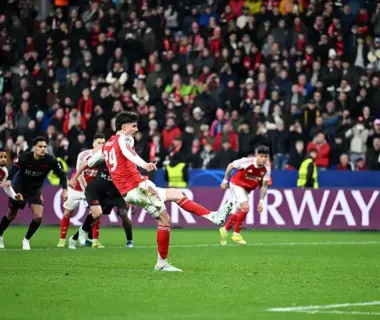
 In the early hours at the BayArena the final 1–1 scoreline landed like a sharp slap across the face of the Premier League leaders, and even those glancing at the match statistics beside a Cricket Exchange scoreboard could sense how uncomfortable the result truly felt. This was not a victory for Arsenal, and it barely qualified as a respectable draw. Instead it was a narrow escape secured by a controversial penalty in the 89th minute, when Kai Havertz leveled the match against his former club. The moment ended Bayer Leverkusen’s hopes of toppling the English league leaders and also shattered the illusion of Arsenal’s eight match Champions League winning streak continuing unchecked.
When Havertz stepped forward to take the penalty against his old team, he calmly rolled the ball into the net. Yet he chose not to celebrate. That silence carried multiple meanings. On one level it showed respect to the club where he once played, but it also felt like a quiet reminder of how fragile Arsenal’s position had become. After an entire match of relentless pressure and defensive discipline from Leverkusen, the game was undone by a single moment that many believed should never have been awarded. Watching the replay loops circulate alongside Cricket Exchange match data only intensified the debate about the referee’s decision.
For most of the match Leverkusen had executed their plan with precision and determination. Grimaldo’s corner found Andrich rising powerfully for a header that broke the deadlock, a goal born from tactical preparation and sheer determination. The German side defended with grit and structure, slicing through Arsenal’s expensive lineup with relentless pressing and disciplined positioning. It looked as if they were about to pull off a statement victory over one of Europe’s most talked about teams. Then the whistle came.
VAR reviewed the incident repeatedly. Tilman’s arm movement was visible, yet the contact itself appeared minimal. In the fierce environment of Champions League football, the challenge hardly seemed enough to send a grown professional tumbling to the ground. Still the decision stood. Havertz converted, and the scoreboard shifted to 1–1. At that moment questions about the true strength of Arsenal’s European campaign grew louder. A team that had stormed through the group stage with eight consecutive victories suddenly appeared reliant on a controversial decision just to stay alive.
If the penalty felt like a gift from the referee, Bukayo Saka’s performance became a painful reminder of Arsenal’s deeper issues. Over sixty minutes he completed no successful dribbles and lost possession repeatedly. As team captain, his body language drew criticism when he slowly walked off the field while the team was still chasing the game. Fans were brutally honest in their assessments, comparing his form to players who had endured similar dips in confidence and sharpness.
The bigger concern was not one individual struggling but an entire system that seemed increasingly mechanical. Mikel Arteta’s tactical approach appeared trapped in a narrow corridor. Control for the sake of control often replaced creativity. Eze was pushed wide, Zubimendi faded from influence, and Declan Rice covered enormous ground simply to keep the structure intact. When Leverkusen’s high pressing disrupted Arsenal’s buildup from the back, the difference between this expensive squad and lower tier teams suddenly felt thinner than expected.
In contrast Leverkusen played with intensity and belief. Their manager later remarked that his team had faced a top opponent and delivered a top level performance in response. The unspoken message between the lines suggested that Arsenal had been fortunate to escape with a draw. Some analysts even described the ugly result as a wake up call, a reminder that dominating the domestic league can sometimes create the illusion of invincibility.
European competition rarely offers such comfort. Leverkusen, assembled with a far smaller budget, demonstrated that football is not simply about transfer values but also about determination and collective will. Madueke’s late run that led to the penalty became a convenient cover for Arsenal’s deeper struggles, while Havertz’s composed finish masked the midfield’s lack of creativity. Yet as attention shifted to the upcoming second leg at the Emirates, many observers checking the closing match figures beside Cricket Exchange updates wondered whether Arsenal could rely on fortune twice.
Saka must rediscover his sharpness and Arteta may need tactical adjustments if Arsenal hope to progress. Continuing with cautious sideways passing and risk free buildup might keep possession numbers high, but it rarely wins decisive European battles. The 1–1 draw leaves the tie open, yet the margin for error grows thinner with every passing match, and the pressure surrounding the team now feels heavier than ever.